“Hello! I just wanted to write you a quick note to say thank you so much for having a Giraffe Cam! I live in Austin, Texas and I think the World Zoo blog mentioned your zoo and giraffe cam. Well now I can't live without it! I have the page open everyday at work, and it really helps me get through the day when I can pop over and see the beautiful babies. Giraffes are my favorite animal, I love them very much, and you have given me a great gift.” - AP
We are so proud of our giraffe herd here at Cheyenne Mountain Zoo. To find out more about their daily “stampede” see our Giraffe Cam.
April 28, 2009
April 24, 2009
Create a Butterfly Garden!

Dozens of butterfly species commonly occur along Colorado’s Front Range and are a welcome garden addition. Prolong the stay of these colorful insects and draw in others by providing the food and shelter they need.
Visit the Horticulture Section of our website to learn how you can plant your very own butterfly garden at home.
April 23, 2009
Wild Orangutan News

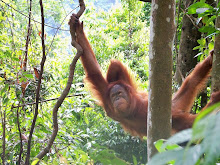
Conservationists have discovered a new population of orangutans in a remote corner of Indonesia, giving a rare boost to one of the world's most endangered great apes! Read the entire story.
To find out how you can help orangutans in need and help with conservation efforts, visit our website.
April 22, 2009
The Green Within our Gates

Happy Earth Day!
When you step inside the gates at Cheyenne Mountain Zoo, you are entering a world committed to sustainability. Every decision we make impacts our environment in some way and we are doing our part to keep our Earth “green”.
Here are just a few ways in which Cheyenne Mountain Zoo is committed to helping our environment:
• ECOWARE: Supplied by Ecoware, many of our eatery products are compostable or recyclable. While here, you may use cups and utensils made from corn. Made from compostable PLA plastic, derived from U.S. grown corn, these products will naturally decompose back to organic elements. Our plates are made from 100% sugarcane fibers and naturally biodegrade when composted.
• RECYCLING PROGRAM: We recycle aluminum cans, donating the proceeds to the Zoo's animal enrichment program in partnership with the American Association of Zookeepers' local chapter. The Zoo also recycles plastic, newspaper, office paper, cardboard, paperboard, Christmas trees, ink-jet and laser cartridges, toner cartridges, cell phones and batteries. Staff reuses materials whenever possible—from using empty feed sacks and cardboard boxes for animal enrichment to using fallen trees and branches for perches and props.
• EDUCATION: Our education programs and events emphasize the importance of recycling and conservation to members of the community. Have you visited the LOFT in Rocky Mountain Wild?
• WATER CONSERVATION: The Zoo builds constructed wetlands within new exhibits, enabling the reuse of water from other exhibits, significantly reducing the demand for new water. The Zoo's horticulture program introduced native, drought-tolerant plant species throughout the Zoo and employs smart watering practices.
• ENERGY CONSERVATION: We use energy-efficient light bulbs and fixtures and clean HVAC filters regularly. We began making a switch toward use of gas-free push mowers when we discovered that running a mower for one hour produces the same amount of pollution as driving a car 350 miles!
Emphasizing minimal disruption and maximum preservation of the natural environment is a priority at the Zoo. Join us at the Zoo Sunday June 12 for EarthFest, an event highlighting what local groups are doing and what everyone can do to help conserve natural resources in their every day lives.
April 21, 2009


April 17, 2009
The Loneliest Animals – Sunday April 19, 7PM on PBS

The loneliest animals are the most endangered species on the planet. Protected by dedicated scientists, these animals represent the end of the line for their species. In many cases, intensive captive breeding programs have been launched with the aim of sustaining these animals and the hope of returning them to the wild.
Viewers will be taken into high-security, high-tech labs where scientists attempt to breed new generations and into the field to discover what forces have led to the demise of entire species.
Featured animals include Yangtze turtles under 24-hour surveillance; a baby Sumatran rhino; a special collection of lemurs; the Spix's macaw, a bird declared extinct in the wild in 2000; and "Lonesome George," a giant tortoise from the Galapagos, who is the last of his kind.
Local viewers can see The Loneliest Animals on Rocky Mountain PBS on Sunday, April 19 at 7PM.
April 15, 2009
Name the Baby Orangutan!

Cheyenne Mountain Zoo’s 21–year-old Sumatran orangutan, Sumagu, gave birth to a male orangutan baby on February 19. Now it's time to give this little guy a name and you can help!
Of the four preliminary names selected by Primate World staff at Cheyenne Mountain Zoo, you can vote for the name you think best fits the baby orangutan. Zoo staff chose the Indonesian names based on the baby’s personality and characteristics. To see the name choices and to vote, visit our website.
Ten finalists will be selected by Cheyenne Mountain Zoo from all eligible entries and notified to attend the name selection celebration on Saturday, May 9 at 10:30 a.m. in the Zoo’s Primate World building. After the little orangutan’s new name is announced, one finalist name will be drawn to win the Grand Prize of a special behind-the-scenes Zoo experience for the winner and five close friends.
Deadline for voting in Monday, May 4 at 5 p.m.
Vote HERE!

April 14, 2009
Siamang Calls
Siamang calls are legendary. All gibbons can make amazingly loud sounds, and the siamang’s vocalizations include howls and bellows magnified by the inflatable throat sac. These boisterous calls can be heard up to two miles away through forest vegetation and are used primarily for claiming territory, which can be as large as 50 acres.
Males, females and older offspring all get involved in the displays. Bahana is 3 ½ years old and calls with her parents. Her first calls sounded like a hoarse, high-pitched crowing vocalization!
Siamangs perform impressive athletic displays while they are doing the territorial calls, including swinging, stomping, shaking branches, and leaping from tree to tree. Wayan (the male infant) clings tightly to his mom while she is displaying.
Siamang calls, sometimes lasting 30 minutes or more, can be heard daily in Primate World at Cheyenne Mountain Zoo.
Check out our latest “Siamang Calls” video on our YouTube Channel:
Males, females and older offspring all get involved in the displays. Bahana is 3 ½ years old and calls with her parents. Her first calls sounded like a hoarse, high-pitched crowing vocalization!
Siamangs perform impressive athletic displays while they are doing the territorial calls, including swinging, stomping, shaking branches, and leaping from tree to tree. Wayan (the male infant) clings tightly to his mom while she is displaying.
Siamang calls, sometimes lasting 30 minutes or more, can be heard daily in Primate World at Cheyenne Mountain Zoo.
Check out our latest “Siamang Calls” video on our YouTube Channel:
April 13, 2009
Bowling for Rhinos this Saturday!!

This fun event has been re-scheduled for this Saturday, April 18th starting at 10am on the greens at the Lodge at Moose Lake near Rocky Mountain Wild.
Munch on some homemade goodies from our bake sale after you crash into 5 foot tall bowling pins in our giant inflatable human bowling alley! Then take the "Rhino Discovery Trail" where your family can learn how to act and live like a rhino.
Then at 1pm, it’s the Zoo animals’ turn to bowl! The elephants and hippos will have large barrels to knock over, either with giant boomer balls or themselves!! The tiger cubs will enjoy paper mache bowling pins and the moose will stomp a box painted to look like a pin. Other animals such as otters and meerkats will also have their chance to “bowl” for rhinos.

Then on the evening of Saturday April 18, join us for an exciting night of "human" bowling from 6pm to 8pm at Brunzwick Zone located at 999 N. Circle Drive, to help raise much needed funds for rhino conservation!
Organized by the American Association of Zookeepers (AAZK), Bowling for Rhinos is a national event held each year to raise awareness and money for rhino conservation.
Since the event’s beginning in 1990, Bowling for Rhinos has raised over $3 million nationally, with our local chapter raising $20,000 for the cause!
Not a bowler? The evening will include food, prizes, the Cheyenne Mountain Zoo’s Animal Ambassadors and other fun activities. So join us and support the amazing rhinoceros!
For registration information, vist our website.
* Bowling for Rhinos is an annual fundraising event held by local chapters of the American Association of Zookeepers across the country. 100% of the funds go to rhino conservation in Africa and Indonesia.
April 10, 2009
Help Wild Animals Stay Wild

As a kid, the thought of having a raccoon as a pet sounded fun. After all, they look so cute and cuddly. We see this scenario of families taking in wild animals as pets all too frequently in Colorado. Many people are unaware that you just cannot remove a wild animal from the woods and take it home.
Colorado takes a conservative stance on private ownership of wildlife. In general, it is illegal to own wildlife in Colorado. As a public resource, wildlife belongs to the state of Colorado, to all citizens.
Information from the Colorado Division of Wildlife explains state laws and regulations governing wildlife as pets—what’s legal and what's illegal to own, and why.
Enter Tigerlily, our fabulous and amazing skunk and very popular animal ambassador. Tigerlily came to the Zoo from a private owner. When her family realized that it was illegal to own a skunk in the state of Colorado, they called Cheyenne Mountain Zoo.
Having been socialized within a family unit, Tigerlily now very much enjoys her visits as an outreach animal through our Zoo on the Move Program, where everyone can learn about her natural behaviors. As an animal ambassador for her species, she helps teach people why wild animals should stay wild.
To learn more about Tigerlily, visit the Animal Highlights section of our website then see Tigerlily’s recent TV debut on Fox 21’s Morning News.
April 9, 2009
Hop up to the Zoo for an “Easter Egg Extravaganza”

After all the hidden eggs have been found this Easter Sunday, bring the extras to Cheyenne Mountain Zoo for an "Easter Egg Extravaganza"! Weather permitting, keepers will be collecting old fashioned hard-boiled and dyed Easter eggs at a variety of locations and times throughout the Zoo, then feeding them to the animals.
Keepers ask that only dyed hard-boiled eggs be donated for this event please. Animals cannot eat eggs embellished with paint or markers, stickers, glitter or any other alterations. One egg per child per area will be collected for distribution.
Visit our website for an Easter egg feeding schedule. Thank you for being a part of this special and enriching day for our animals!
April 7, 2009
Grizzly Play
While many of us were digging out from the late March blizzard, Grizzlies Emmett and Digger made the most of the Rocky Mountain Wild weather:
See more of Cheyenne Mountain Zoo's videos on our YouTube Channel!
See more of Cheyenne Mountain Zoo's videos on our YouTube Channel!
April 3, 2009
Frogs: The Thin Green Line
.jpg)
Boreal Toad – Photo Credit: Joel Sartore
Frogs have been living on this planet for more than 360 million years, and over the centuries, evolved into some of the most wondrous and diverse creatures on earth.
Recent discoveries are startling: more than a third of all amphibians – most of which are frogs and toads – have already been lost, and more are disappearing every day.
A fungus called chytrid has been identified as the major culprit, and so far the spread of the fungus can’t be stopped. Filmmaker Allison Argo discusses these challenges in her film Frogs: The Thin Green Line.
Check your local PBS station for listings. Colorado viewers can see the film on Rocky Mountain PBS/KTSC at 7:00 pm, Sunday April 5.
April 2, 2009
"Mad about Marmosets" Update
The "Mad about Marmosets" event previously scheduled for Saturday, April 4 from 10am - 2 pm in front of Monkey Pavilion has been postponed.
The new date and time will be posted as soon as it is available.
The new date and time will be posted as soon as it is available.

Tumani's Troops Update

Thank you to our fabulous group of Tumani’s Troops volunteers!
Last week, the Troops congregated in Primate World where they made enrichment items for the gorillas.
Animal enrichment is the process of providing stimulating environments for Zoo animals in order for them to demonstrate their species-typical behavior, to allow them to exercise choice over their environment and enhance their well-being.
Enrichment includes the design of stimulating and naturalistic enclosures, the introduction of objects, sounds, smells and other stimuli to the animal’s environment.
Hiding ½ teaspoon of peanut butter inside a recycled cardboard toilet paper tube, along with a piece of dried fruit and some popcorn, makes a special treat for the primates. Zoo staff fondly refers to these special treats as “canollies”. It’s one of our animals’ favorite forms of enrichment!
For more on how you too can become part of Tumani’s Troops, a special group dedicated to gorilla conservation, visit our website.
Subscribe to:
Posts (Atom)

 Posts
Posts