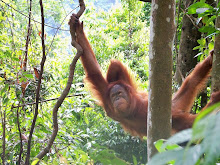
Fan Photo by Juliana Vigil
Did you know that Cheyenne Mountain Zoo has a moose? His name is Tahoma and he is in the process of getting his new antlers. We thought you might like to know a little more about it since we receive so many questions everyday.
Moose live in the northern parts of America and Eurasia. The biggest moose can be as high as seven feet at the shoulders and weigh over 1,300 pounds. The males have broad, palm-like antlers up to six feet across and the rack can weigh up to 90 pounds.

Tahoma dropped his antlers mid-January 2010. This was a bit earlier then we anticipated because he dropped his first set in March the previous year, but moose drop their antlers anytime from January to March so he was in the normal range. About mid-March Tahoma's new antlers started to grow. The grey spots where they were growing was very warm to the touch, and it seemed like everyday the bumps were getting bigger. Many people thought that the grey caps covering his antlers were something that the Zoo had put on him, but actually it’s a natural part of his body and the process of creating a new rack. It is now spring, and Tahoma’s antlers are well on their way. They are about 4 inches long! They are covered in velvet and are approximately 2 inches wide.
This will be Tahoma's third rack. We are very excited because in the third year, the palm shape starts to show in the antlers. We are excited to see how his third rack turns out and just how much bigger it will be versus the last two years.
 Moose are the largest of the elk family, and like deer, moose they drop their antlers every winter and start to grow a new set in the Spring. Only male Moose, called bulls, grow antlers which they use to defend territory and attract the female moose, called a cow. While the antlers are growing they are covered with a soft brown covering called velvet (it even feels like velvet!) that provides a blood supply to the fast growing antlers. Inside the growing rack looks a bit like honeycomb but once fall comes and the antlers are done growing the inside will start to harden, the blood flow to the antlers will start to be cut off and the moose will start to rub the velvet off. Tahoma rubs on the trees in his exhibit in order to remove the velvet. It is definitely a sight to see!
Tahoma's antlers continue to grow and change everyday. We will keep you posted on as they grow and form through the summer months. Stop by Rocky Mountain Wild to see Tahoma up-close and check out our keeper talks daily to learn more! Be sure to post your pictures of Tahoma in our fan photos on our facebook page.
Moose Feeding and Keeper Talk
When: Daily, 3:15 p.m. (weather permitting)
Where: Rocky Mountain Wild, at moose
What: Let us introduce you to Tahoma, our resident moose.


 Posts
Posts