Welcome to Cheyenne Mountain Zoo’s official blog! From amazing animal stories to a "behind the scenes" look at daily zoo life, this is the place to get to know
Cheyenne Mountain Zoo on a more personal level.
Check back often to get In Between the Spots!
Showing posts with label Wild Animals. Show all posts

September 13, 2012

Antler Velvet + Stomachs = A Rocky Mtn. Wild Update

Tahoma has officially finished growing his 5th set of antlers and is now shedding the velvet off of them! Moose bulls grow new antlers every year and the velvet helps them grow. Once they are done moose will rub their antlers on branches to help shed the velvet and reveal their new antlers underneath. Keepers will use Tahoma's velvet for enrichment. Especially for carnivores like, wolves, bears and cats!


Our two grizzly bear boys Emmett and Digger are feeling the season change! Especially their stomachs! Both bears are super hungry and have been observed squabbling over even the smallest morsel like a raspberry or peanut. Bears start to bulk-up this time of year in preperation for denning up over the winter. Keepers have increased E & D's diets and they are eating it all, even their veggies!

August 14, 2012

Baka-keri: The Eternal Ape


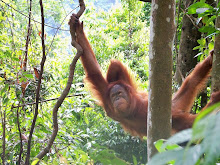
Many of our frequent guests are probably already familiar with Baka-keri, our adult male Sumatran orangutan.  No, he’s not the orangutan who gives “kisses”; that’s Tujoh.  Baka is the handsome, dreadlocked guy who was a great dad to Makan and now Godek. 

We frequently get questions about Baka’s name because the word “baka” means stupid in Japanese.  Baka is one of our smartest orangutans and anything but stupid.  He was named at his birth zoo, the Calgary Zoo, which follows similar naming rules as Cheyenne Mountain Zoo.  We try to give animals names from languages native to their country of origin.  Orangutans are native to the islands of Borneo and Sumatra in Indonesia and Malaysia.  Baka’s full name is Baka-keri - Baka in Indonesian means “eternal”, and the Indonesian word for “ape” is keras.
  
Orangutans are highly endangered in their native rainforests due palm oil production, so right now they are far from eternal.  Click here to see how you can help them when you visit the grocery store.

July 12, 2012

Helpful Hippo Behaviors

Wicket’s keepers are currently working on training her to demonstrate numerous behaviors that Kasai and Zambezi currently illustrate. These behaviors are instilled into our hippos to help manage their care and welfare.

  • Stationing is when the hippo faces the keepers and holds their chin up on the top rail of the exhibit. This allows the keepers to get a good look at her skin and medicate some dry/cracked spots if necessary using a spray bottle.
  • Target training is where the keepers place a tennis ball on the end of a pole and have the animal touch it with their nose when they hold it out. This is helpful when they are working with more than one animal in the stall at the same time; one can be "led" away from the other so training is less confusing for them.
  • The open mouth command is important, so keepers can look inside the hippo’s mouth, check for cracks in their teeth, check for sores, and alleviate tusk problems in case they need to address them. We also brush the hippo’s teeth daily and get any debris out from between their teeth. Oral care is important in hippos so opening their mouth for keepers to perform daily hygiene is a necessity.
  •  A to B training is a good way to see how the hippos are moving. We can ask them to come to "point A" (where the keeper is), when they do we reward them, and then we ask them to go to a designated "point B" (across the yard or pool) and back again.

July 10, 2012

Training Wicket

When it comes to teaching and maintaining desirable behaviors with animals, a positive trusting relationship is the first ingredient. Currently, we are working on building a trusting relationship with Wicket, our new hippo from the Brookfield Zoo in Chicago. She is shy, but does respond to special treats like cantaloupe, popcorn, and bread. Unlike Zambezi and Kasai, Wicket backs away from touch and has been slow to respond to us, her new keepers. While at the Brookfield Zoo she was trained to open her mouth on command, she has continued to demonstrate this behavior, which is a good start. She does allow keepers that she’s "comfortable with", to scratch her tongue and brush her teeth. As with most trained animals, practice makes perfect, so we will continue to practice this behavior with her while we work on building a trusting relationship.

Our overall training goal with Wicket is to instill the same behaviors Kasai and Zambezi illustrate including: stationing, target training, refining the open mouth behavior to allow for proper oral care, and doing some A to B work with her as well. We will post a short blog defining what each behavior consists of and why we train the specific behaviors later this week.

Wicket is beginning to adjust to her new pool and stall. Along with, Zambezi and Kasai, they have all been curious about one another with interaction through the bars several times a day. This interaction is all part of the introduction phase but the stressful part is still to come. Placing a new animal in an already established group will be challenging and there will be an adjustment period.

We have our work cut out for us, but with time and patience we anticipate Wicket to be a happy hippo here at Cheyenne Mountain Zoo.