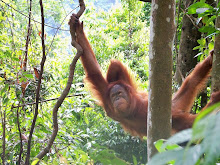
Help save the majority of remaining lowland forests in Aceh,
Indonesia---the last few strongholds for the Sumatran tiger, elephant, rhino
and orangutan. Please click on the link (www.change.org/LeuserHeritage),
and let the government of Aceh know that is important to save the Leuser
Ecosystem and the endangered species that call it home!
December 11, 2013

December 2, 2013
Black-footed ferrets released in Colorado!
After 23 years of breeding
endangered BFFs, black-footed ferrets born at CMZ are now living in the wild on
privately-owned prairie lands of Colorado. Staff members from our Zoo, along
with U.S. Fish and Wildlife Service (USFWS), released captive-bred black-footed
ferrets (BFF) on the Walker Ranch near Pueblo at the end of October and
beginning of November. In total, 55 BFFs were released at the ranch – five of
those were born and raised at Cheyenne Mountain Zoo! This release was the first
in Colorado on privately owned land and was made possible by new Safe Harbor
Agreement (SHA).
 “It took many dedicated
organizations working together for this release to take place. A special thanks
goes to Gary and Georgia Walker, who volunteered their land, for giving ferrets
a chance to survive in the wild prairies of Colorado,” Dr. Della Garelle,
Cheyenne Mountain Zoo’s Director of Conservation and the Species Survival Plan
Chair for the international black-footed ferret breeding team said. “We wish
the black-footed ferrets well; go forth, eat prairie dogs and prosper!”
“It took many dedicated
organizations working together for this release to take place. A special thanks
goes to Gary and Georgia Walker, who volunteered their land, for giving ferrets
a chance to survive in the wild prairies of Colorado,” Dr. Della Garelle,
Cheyenne Mountain Zoo’s Director of Conservation and the Species Survival Plan
Chair for the international black-footed ferret breeding team said. “We wish
the black-footed ferrets well; go forth, eat prairie dogs and prosper!”
An off-exhibit breeding facility was
built on grounds after the Zoo joined the Black-Footed Ferret recovery effort
in 1990. Since the first BFF breeding
season at the Zoo, 456 kits have been born and 227 ferrets have been released.
In total, there have been 21 sites in 12 states where black-footed ferrets have
been reintroduced since 1991, but only 4 of those are currently successful.
 “Black-footed ferrets are nocturnal
and live underground in prairie dog burrows, so it is difficult to determine their
exact population, but they’ve gone from extinct in the wild to at least 500 now
roaming prairie dog colonies,” Garelle said. “Our Zoo choose to participate in
this breeding program because we are passionate about saving species from
extinction – and what more appropriate animal for us to save than one that used
to exist right here in Colorado.”
“Black-footed ferrets are nocturnal
and live underground in prairie dog burrows, so it is difficult to determine their
exact population, but they’ve gone from extinct in the wild to at least 500 now
roaming prairie dog colonies,” Garelle said. “Our Zoo choose to participate in
this breeding program because we are passionate about saving species from
extinction – and what more appropriate animal for us to save than one that used
to exist right here in Colorado.”
Black-footed ferrets are completely dependent on
vast expanses of prairie dogs as primary prey, and use prairie dog burrows for
shelter and raising their young in prairie dog dens. As prairie dog populations
were decimated to less than 2% of their historical levels due to a non-native plague
and land development, the black-footed ferret became critically endangered. In
1979, BFFs were thought to be extinct, until a ranch dog named Shep found one
in the prairies Meeteetse, Wyoming and presented it to his owner.

Biologist studied this remnant
population, but saw that it was declining rapidly. To safeguard the species and
prevent their imminent extinction, the 18 last-known wild black-footed ferrets
were rescued between 1985 and 1987. In 1986, USFWS, Wyoming Game and Fish, and
the Association of Zoos and Aquariums initiated an emergency captive-breeding
program for black-footed ferrets. Cheyenne Mountain Zoo is one of only six
breeding facilities in the world participating in this program.
To learn more about black-footed
ferrets, visit www.blackfootedferret.org, or stop into The Loft at the Zoo, and
meet our retired breeding black-footed ferret.
To read more stories from The Waterhole, or to keep
up with the latest news, events, and behind the scenes happenings at the Zoo,
sign up to receive e-newsletters: http://www.cmzoo.org/aboutZoo/pressBox/waterhole.asp.
November 15, 2013
Update from Indonesia on the Roundtable on Sustainable Palm Oil (RSPO) Annual Conference
By Dina Bredahl and Tracey Gazibara
 |
Batu Mblein Quarantine Center
|
After 34 hours of traveling, we arrived in Medan , Indonesia
Before beginning the conference on Tuesday, we were able to
meet with Dr. Ian Singleton with Sumatran Orangutan Conservation Program (SOCP)
and visit Batu Mbelin quarantine center where nearly 50 orangutans are being
cared for. Many of the orangutans have been confiscated, as they were being
held illegally as pets. We were excited to hear that several of the orangutans
would be on their way to be re-released into the wild next week.
 |
Dina, Darrel Webber and Tracey at the RSPO.
|
Our goal for this conference was to interact with other
stakeholders to further our work with palm oil sustainability. The keynote address given by Professor Tim
Benton was titled The Challenge of Food
Security in 2050: Can we do it sustainably? It was a detailed look at global climate
change, population growth projections and how agriculture and deforestation now
will affect our future dramatically. It
was very apparent that the success of the RSPO is critical on many levels.
 |
Group session at the RSPO conference.
|
The format of this conference was quite unconventional -- open
space technology was used to encourage anyone to take ‘ownership’ of an issue
they cared about and invite any and all interested attendees to join the
conversation. We facilitated a
discussion called ‘How can zoos positively transform the market?’ along with others
from San Diego Zoo, Zoos Victoria and the Zoological Society of London. We were happy to have representatives from
the growers’ stakeholder group participate in our session to learn more about
their needs. We also joined in on other
great topic discussions as well, and really learned a lot about the
perspectives of others during this process.
 |
Voting on resolutions at the RSPO.
|
November 7, 2013
Training a Herd of Giraffes
Cheyenne Mountain Zoo is well-known
for our giraffe herd. People are excited to feed the docile giants face to face
– currently there are 19 roaming the Zoo’s African Rift Valley. Everyday at 2
p.m., guests can also take a front-row seat to watch our giraffe training
program in action.
 Cooperative husbandry
training helps animal keepers care for the giraffes. This may seem like
technical “zoo-speak,” but basically it means that our animals are trained to
be willing participants in their own care. This willing participation means
safer and less stressful procedures for both humans and animals. Much of this
training is focused on hoof work, because just like fingernails, hooves grow. It
is important that they get trimmed regularly.
Cooperative husbandry
training helps animal keepers care for the giraffes. This may seem like
technical “zoo-speak,” but basically it means that our animals are trained to
be willing participants in their own care. This willing participation means
safer and less stressful procedures for both humans and animals. Much of this
training is focused on hoof work, because just like fingernails, hooves grow. It
is important that they get trimmed regularly.
“In zoos, eighty percent of
giraffe anesthesia is done to address foot problems,” Dr. Liza Dadone, Cheyenne
Mountain Zoo’s Head Veterinarian, said. “Anesthetizing a giraffe is dangerous.
The animal training that the keepers are doing is taking out the need for that
high-risk anesthesia for our herd.”
In March, animal keepers
chose two giraffes to start foot training, Lakish and Mahali. They were
presented with a sturdy wooden box and were given voice commands (left or
right). As the giraffes learned to place a foot on the box, they were then
given a second command, “touch.” Animal keepers would then touch their foot.
Eventually, the giraffes’ training progressed to the point where they would
present their foot on the box, curl their foot up and hold it in that position,
while a farrier (hoof specialist) trimmed it. Currently 12 of our 19 giraffes
present their feet for regular farrier work, x-rays or laser therapy.
“It’s truly amazing how far
we’ve come in just a short amount of time,” Amy Schilz, Head Giraffe/Lion
Animal Keeper, said. “A number of people are really surprised at how smart
giraffes are, and how quickly we can cooperatively capture husbandry
behaviors.”
 In addition to hoof work, the
animal keepers also work with the giraffes on shifting, targeting their nose to
a tennis ball, cooperative blood draws, neck stretches and standing still on a
scale. One female, Msitu, is even trained to allow keepers to conduct an
ultrasound test on her. This is how the veterinary team and keepers knew she
was pregnant with our newest giraffe calf, Emy, born on August 1.
In addition to hoof work, the
animal keepers also work with the giraffes on shifting, targeting their nose to
a tennis ball, cooperative blood draws, neck stretches and standing still on a
scale. One female, Msitu, is even trained to allow keepers to conduct an
ultrasound test on her. This is how the veterinary team and keepers knew she
was pregnant with our newest giraffe calf, Emy, born on August 1.
“All of our giraffes are
given the opportunity to train,” Amy said. “Even Emy, who is only two months
old, has started target training.”
All of the giraffes are
trained with positive reinforcement – meaning when a giraffe chooses to
participate in training they are rewarded with giraffe crackers and other
healthy giraffe treats. If they don’t want to participate that day, they can
choose to simply walk away. Amy also explained that each giraffe has a
different training regimen and that each giraffe responds to different cues,
verbals and techniques.
“It’s like a puzzle,” Amy
said. “That is the fun part for me, figuring out what each giraffe is going to
respond to.”
In addition to cooperative
husbandry behaviors, the three giraffe animal keepers work on capturing some of
the giraffes natural behaviors (like sticking their tounge out or bowing for
water) on a training cue. Next time you are at the Zoo, check out our giraffe
herd’s positive reinforcment training in
African Rift Valley.
To read more stories from The Waterhole, or to keep up with the latest news, events, and behind the scenes happenings at the Zoo, sign up to receive e-newsletters: http://www.cmzoo.org/aboutZoo/pressBox/waterhole.asp.
To read more stories from The Waterhole, or to keep up with the latest news, events, and behind the scenes happenings at the Zoo, sign up to receive e-newsletters: http://www.cmzoo.org/aboutZoo/pressBox/waterhole.asp.
October 11, 2013
Boo at the Zoo Checklist

Thousands of excited families are planning their
trick-or-treat adventure to Cheyenne Mountain Zoo’s Boo at the Zoo on October
18-20, 25-27 and 31. To ensure you won’t miss any of the merry-not-scary
activities, we've made a Boo at the Zoo checklist!
- Wear layers - Colorado weather can be warm one minute and chilly the next - wear layers so you can stay toasty warm during Boo at the Zoo.
- Wear comfortable shoes – We are America’s only mountain zoo, so don’t forget to coordinate your comfy shoes when you’re planning your costume.
- Bring a bag – We will have Spooky Treat Stations set up around the Zoo with plenty of candy for everyone (made with sustainable palm oil, of course), so don’t forget to bring your reusable bag to hold all your treats. If you forget, we’ll have bags available at the admission gate for $2.
- Bring a flashlight – We have minimal lighting around the Zoo in keeping with the theme, so little ghosts might like a little extra light when trick-or-treating in the night.
- Catch the stage show – Don’t miss the animal/keeper performance of “So You Want to be a Zoo Keeper?” at the Lodge at Moose Lake nightly at 5:25 p.m., 6:25 p.m. and 7:25 p.m. Be sure you’re prompt – the show involves free-flight birds, so late arrivals will not be admitted.
- Save room in your belly –
Candy isn’t the only delicious treat at Boo! Elson’s Place will have sweets like
hot chocolate and waffles, Grizzly Grill is a great place for a family dinner
and The Overlook will be serving up some upscale delicacies.

- Superheroes like to soar – The Mountaineer Sky Ride will be taking little superheroes and their families to the top of the Zoo during all seven nights of Boo! Opt for the Boo/Sky Ride combo ticket at the admission gate to save $2 per person. The last ride up is at 8 p.m., so plan ahead.
- Don’t miss the animals – Select animal exhibits will be open, including giraffes, The Loft, Monkey Pavilion, Encounter Africa and Aquatics. Plus there will be two animal demos nightly – 5 p.m. and 7 p.m. The lions, elephants, hippos, monkeys, meerkats, black rhino and giraffes will receive pumpkins, crepe-paper ghosts, bug-filled gourds and more during enrichment times. Check the online schedule (www.cmzoo.org/boo) to know what animals are featured during the night you attend Boo.
- Renew or Purchase a membership – Zoo members get a special admission discount of $5 per person. Don’t forget to renew or purchase your membership prior to Boo at the Zoo (Zoo memberships are not available for purchase or renewal at Boo.)
- Arrive with enough time
– In addition to trick or treating, animal demos and a stage show, Boo atthe Zoo also has a Lighted Pumpkin Patch, Haunted Fun House, Ghoulish Graveyard, Boo Carousel and Pirate Cove. Make sure you arrive with enough time to see and do everything – Boo hours are from 4-8:30 p.m. each night with the last admission sold at 7:30 p.m.


For
more information about Boo at the Zoo, visit www.cmzoo.org/boo.
Boo at the Zoo is sponsored by Larry H. Miller Toyota, Liberty Toyota of
Colorado Springs, Children’s Hospital Colorado, Colorado Springs Pediatric
Dentistry and Sam’s Club.
Subscribe to:
Posts (Atom)

 Posts
Posts